Flock Cameras is running a mass surveillance on American citizens
Home Depot and Lowe’s are running a mass surveillance on their customers
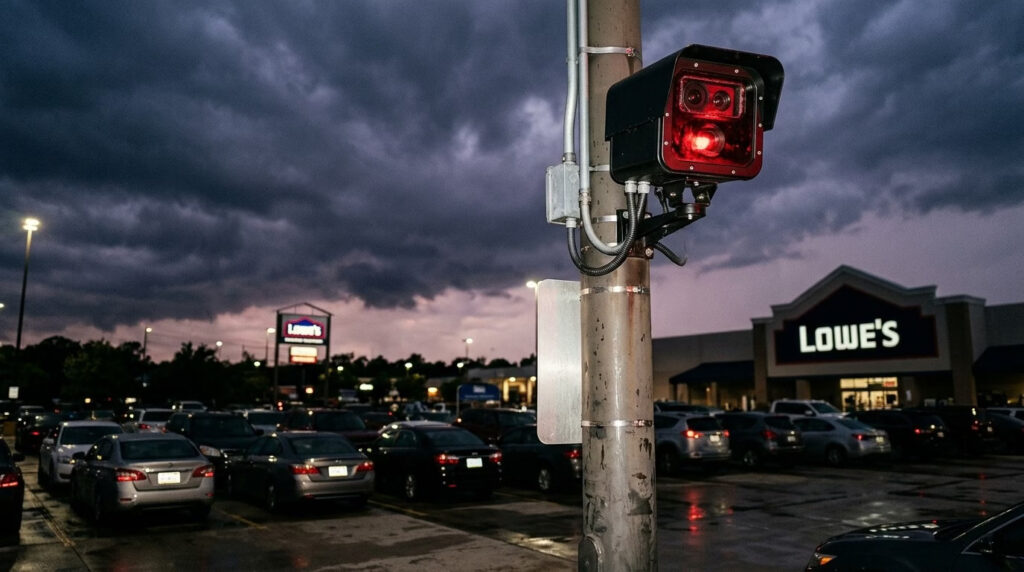
Home Depot and Lowe’s, two of the country’s most popular home improvement stores, are contributing to the massive surveillance dragnet coordinated by Flock Spy cameras. Do customers know that these stores are collecting their data and sharing indiscriminately? Probably not. Have these companies given thought to how this data might put their customers in danger, whether it’s cops stalking their exes or aggressive ICE agents targeting yard workers? Probably not. If these companies want customers to feel safe in their homes, then they should make sure they’re also safe where they buy their supplies.”
Americans are destroying Flock surveillance cameras
Brian Merchant, writing for Blood in the Machine, reports that people across the United States are dismantling and destroying Flock surveillance cameras, amid rising public anger that the license plate readers aid U.S. immigration authorities and deportations.
Flock is the Atlanta-based surveillance startup valued at $7.5 billion a year ago and a maker of license plate readers. It has faced criticism for allowing federal authorities access to its massive network of nationwide license plate readers and databases at a time when U.S. Immigration and Customs Enforcement is increasingly relying on data to raid communities as part of the Trump administration’s immigration crackdown.
Flock cameras allow authorities to track where people go and when by taking photos of their license plates from thousands of cameras located across the United States. Flock claims it doesn’t share data with ICE directly, but reports show that local police have shared their own access to Flock cameras and its databases with federal authorities.
While some communities are calling on their cities to end their contracts with Flock, others are taking matters into their own hands.
Merchant reports instances of broken and smashed Flock cameras in La Mesa, California, just weeks after the city council approved the continuation of Flock cameras deployed in the city, despite a clear majority of attendees favoring their shutdown. A local report cited strong opposition to the surveillance technology, with residents raising privacy concerns.
Other cases of vandalism have stretched from California and Connecticut to Illinois and Virginia. In Oregon, six license plate-scanning cameras on poles were cut down and at least one was spray-painted. A note left at the base of the severed poles said, “Hahaha get wrecked ya surveilling fucks,” reports Merchant.
According to DeFlock, a project aimed at mapping license plate readers, there are close to 80,000 cameras across the United States. Dozens of cities have so far rejected the use of Flock’s cameras, and some police departments have since blocked federal authorities from using their resources.
A Flock spokesperson did not say, when reached by TechCrunch, if the company keeps track of how many cameras have been destroyed since being deployed.
Police address growing network of Flock Safety cameras across Brazos County
Police say the cameras capture vehicle data used to track down suspects in active investigations.
BRAZOS COUNTY- More than 30 cameras are quietly watching the roads of Bryan-College Station, scanning license plates, logging vehicle details, and helping police solve murders. Not everyone is comfortable with that.
How Flock cameras work
Flock Safety builds these devices, best known as Flock cameras, and they work differently from standard stoplight cameras. They are automatic license plate readers that can operate independently or be mounted to existing city infrastructure. Flock not only photographs the rear of passing vehicles to capture license plate numbers, but it also records the vehicle’s make, model, and defining features.
“Markings, dents, stickers, anything like that used for criminal investigations,” College Station Police Department Public Information Officer David Simmons listed.
Investigators can search the Flock database by vehicle features, helping link cars to thefts, murders, and missing-persons cases. Bryan Police Department Public Information Officer Seth Waller said the technology has already contributed to solving cases locally.
“One specific one that I can talk about is the 2022 murder of Miss Perry, who was an Uber driver, and a Flock hit on that vehicle that was stolen from her down in Del Rio,” Waller explained. “That was crucial in helping solve the murder case for us here at Bryan.”
More cameras bring privacy concerns
Not everyone supports the expanding camera network. Bob Smentana, a member of the group DeFlock, said the technology raises concerns about privacy and the amount of data being collected.
“I think it’s not something that should be allowed to happen. And I think the only solution here is not to collect that data. I think it’s too dangerous for anybody to have,” Smentana said.
DeFlock is a national organization that encourages communities to remove the cameras or limit their abilities. Members of DeFlock and their supporters say Flock cameras create “mass surveillance” by compiling video of where vehicles travel over time. Many are concerned about how long the data is stored and who ultimately has access to it.
“I don’t think that Flock or their management have any malice, I think they believe themselves to be working for the good guys and doing the right thing,” Smentana said. “I think it would do them well to pick up a history book.”
Data storage and who can access
Law enforcement officials say the cameras serve a public safety purpose and that all collected data is protected.
“Flock isn’t taking any of that data and selling it,” Simmons said. “We’re not looking at trying to see what your locations are, the everyday citizen. We are truly trying to utilize this technology to protect our communities.”
Only Brazos County law enforcement agencies have access to data recorded from the Flock cameras they have installed. The system automatically deletes any data not connected to an active investigation after 30 days.
“We own the cameras, we own that data,” Waller said. “Data is stored for 30 days, and after 30 days, if there’s not a search for that information, it’s gone.”
Retailers like Lowe’s and Home Depot have installed Flock cameras in their parking lots to reduce crime. These businesses can choose to share that data with law enforcement, but do not always do so.
“You’ll see a lot of Home Depots, Lowes, lots of retail businesses can purchase Flock cameras, and then they choose to share that,” Simmons said. “They can share it statewide to each agency but it’s an option they don’t have to share.”
Flock network expected to expand
More than 30 Flock cameras are now installed across Bryan and College Station, and police say the network will keep growing.
“It’s honestly just a huge blessing that we have the support of our city councils to be able to purchase this technology,” Waller said. “They help solve crime and produce the information and investigative tools that we need so as long as that is happening, our city is going to be there to support us and what we need to get those cameras and help solve crime.”
This week, the Bryan City Council approved installing five additional cameras on Texas Department of Transportation (TxDOT)-maintained roadways, and College Station is following suit.
Officer Simmons said College Station is currently installing additional cameras across the city.
“It’s going to expand,” Simmons said. “I think we currently have three, and we have a lot more coming.”
With more Flock cameras on the way, the twin cities want to make it clear: crime is not welcome in Aggieland.
“Our goal is always going to be the same, and thats to hold people accountable for their actions,” Simmons added.
Audit Finds No Misuse of Pasadena Police Flock License Plate Reader System
An audit of the Pasadena Police Department’s use of Flock cameras found no evidence of misuse or unauthorized access to the system.
An audit of the Pasadena Police Department’s use of Flock automated license plate reader cameras found no evidence of misuse or unauthorized access to the system, according to a report scheduled for review by the City Council’s Public Safety Committee.
The audit reviewed searches conducted in the Flock system and found they were tied to legitimate law enforcement purposes, including investigations involving stolen vehicles and other crimes.
The review also determined officers followed department policies governing access to the system and that all searches were logged and traceable through the platform’s auditing tools. The report also found that no federal agencies accessed the City’s Flock system or its investigations during the audit period.
The committee will receive a presentation on the department’s use of the system, which captures license plate images and vehicle characteristics to assist investigators in identifying vehicles linked to crimes such as burglaries, vehicle thefts and violent offenses.
Supporters of the technology say the cameras provide valuable investigative leads and allow police to locate stolen vehicles and suspects more quickly.
The systems, typically mounted on poles or traffic infrastructure, operate continuously and convert license plate images into searchable data for law enforcement.
At the same time, Flock automated license plate reader systems have drawn criticism from privacy advocates and some residents in cities across the country who warn that large networks of cameras could allow governments to track vehicle movements over time.
As immigration enforcement has intensified in recent months, residents in several U.S. cities have urged local officials to stop using the system, citing fears of mass surveillance and concerns that locally collected data could be used to support federal deportation efforts.
Flock Safety has contracts with more than 5,000 law enforcement agencies nationwide.
At least 30 localities in Arizona, Massachusetts, Oregon and California have either deactivated their Flock cameras or canceled their contracts.